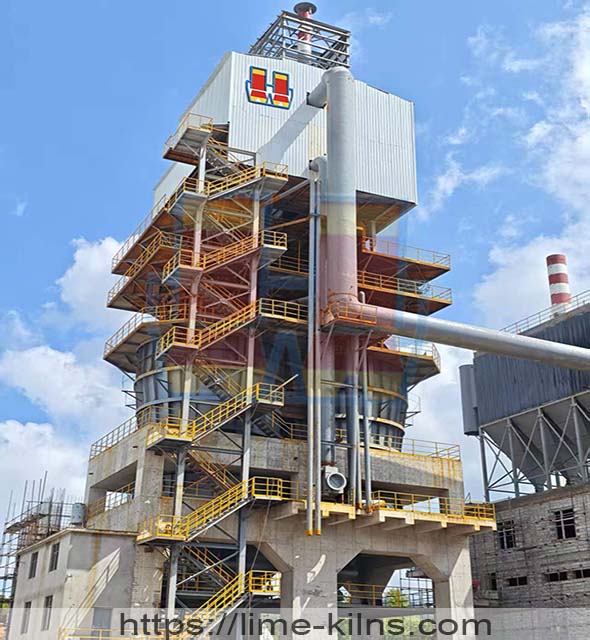
Case in Focus: How Does the PFR Twin-Shaft Kiln Efficiently Calcinate High-Activity Quicklime?
Taking the example of a large building materials group with an annual output of 200,000 tons of active lime, Huixin Kiln custom-designed and supplied a complete set of PFR twin-shaft kiln equipment. This kiln type adopts the twin-shaft alternating heat storage technology, improving thermal efficiency by over 30% compared to traditional shaft kilns.
Working Principle: Limestone (main component CaCO₃) undergoes endothermic decomposition at high temperatures of 900–1100°C, producing calcium oxide (CaO, i.e., quicklime) and carbon dioxide (CO₂). In the PFR twin-shaft kiln, the two shafts alternately serve as the “combustion chamber” and the “heat storage chamber” — the hot flue gas generated in the combustion shaft passes through the connecting channel into the storage shaft, preheating the limestone to be calcined. The exhaust gas temperature can be reduced to below 150°C, allowing full heat recovery.
Key Data from This Case:
-
Finished quicklime activity ≥ 360ml (4 mol/L HCl method), far exceeding that of ordinary shaft kilns;
-
Heat consumption per ton of lime ≤ 900 kcal, with CO₂ emissions reduced by approximately 20%;
-
Over-burned and under-burned rate below 5%, with uniform lime discharge.
Huixin Kiln Delivery Solution: To address the customer’s narrow site and fluctuating raw material particle size, we provided a non-standard kiln design — optimizing the burner layout and feed sealing structure, while equipping an intelligent temperature control system to ensure a stable temperature field inside the kiln. From equipment manufacturing to installation and commissioning, delivery was completed in 90 days, achieving a successful first ignition.